An important visit by UCWEP
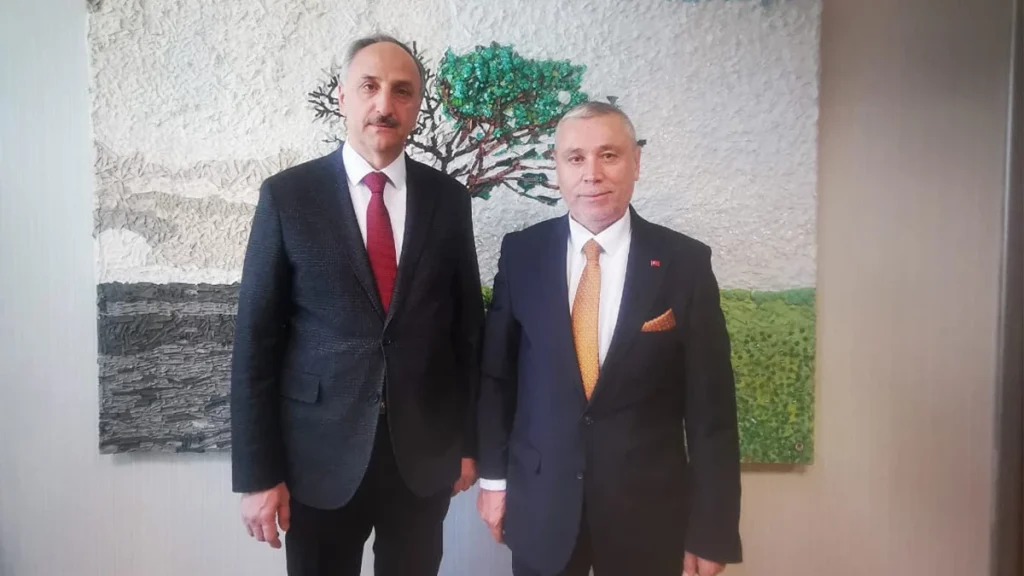
The visit of yeniankara.com.tr Editor-in-Chief and UCWEP President Hasan Taşkın to ÇEM General Manager Kasım Yenigün brought Türkiye’s role in the COP17 and COP31 process back to the agenda.
Our newspaper’s Editor-in-Chief Hasan Taşkın, who is the Chairman of UCWEP, and the General Director of Combating Desertification and Erosion Prof. Dr. His visit to Kasım Yenigün is not just a courtesy meeting; It stood out as a strategic contact that strengthened Türkiye’s claim in global climate diplomacy. During the meeting, the hosting of COP17, which will be held in Mongolia in 2026, and COP31, which is on the agenda to be held in Türkiye in the same year, were discussed.
COP17 AGENDA: NEW PAGE IN THE GLOBAL STRUGGLE
During the visit, preparations for COP17 to be held in Ulan Bator in 2026 within the scope of the United Nations Convention to Combat Desertification (UNCCD) were discussed. It was emphasized to increase international cooperation in the fight against desertification, land degradation and drought.
The fact that the climate change conference COP31 will be held in Türkiye in 2026 was the most striking topic of the meeting. After Australia withdrew its hosting offer, Türkiye officially became the host and according to the plans, it was confirmed that the summit would be held in Antalya.
STRATEGIC COOPERATION BETWEEN ENVIRONMENT AND MEDIA
Prof. took office in July 2024. Dr. During the period when Kasım Yenigün was leading Türkiye’s policies to combat desertification and erosion; UCWEP’s influence in the field of digital media and press freedom is seen as critical for raising social awareness on the environment.
MESSAGE OF THE VISIT: Türkiye AT THE GLOBAL TABLE
The contact between the two institutions was evaluated as an important step aimed at increasing Türkiye’s visibility at the intersection of environmental diplomacy and media power. Ankara’s role is expected to become more evident in the COP17 and COP31 processes.
GLOBAL ALLIANCE TO PROTECT SOIL: UNCCD’S MISSION
The United Nations Convention to Combat Desertification (UNCCD) is an international agreement adopted in 1994 to coordinate the fight against desertification, land degradation and drought on a global scale and today covers almost the entire world; Its aim is to protect the fertility of soils in arid and semi-arid regions, especially in Africa, to popularize sustainable land use and to reduce the chain effects such as poverty, migration and food insecurity caused by these environmental problems. UNCCD is the only global convention that directs governments to develop science-based policies, involve local people in decision-making processes, and produce solutions that enable economic development while protecting the environment.
WHAT IS COP17 AND COP31, WHY IS IT IMPORTANT?
What is COP17?
COP17 is the 17th Conference of the Parties to the United Nations Convention to Combat Desertification (UNCCD) and is the highest-level global platform where the steps taken by countries to combat desertification, land degradation and drought are discussed; At this meeting, governments, scientists and civil society set new targets, discuss financing mechanisms and try to produce joint solutions to land problems, especially food security, migration and climate change.
What is COP31?
COP31 is the 31st Conference of the Parties to the United Nations Framework Convention on Climate Change and is the global climate summit where leaders, scientists and institutions from around the world come together and make decisions on reducing greenhouse gas emissions, climate adaptation policies and green transformation financing; Each COP meeting is seen as a critical turning point where countries update their climate commitments and test the political will to shape the future of the planet.
WHERE IS ULAN BATOR?
Ulaanbaatar is the capital of Mongolia and its largest city, located in the north-central part of the country, in the Tuul River valley; It is also the political, economic and cultural center of Mongolia.
WHY ANTALYA?
Antalya is a city located on the Mediterranean coast in the south of Türkiye, where history and tourism meet in the same frame. While it offers cultural depth with its heritage such as Perge, Aspendos and Side dating back to ancient times; It is a tourism capital that hosts millions of visitors every year with its long beaches, climate and developed infrastructure. It also stands out as one of the strongest centers in Türkiye in terms of congress tourism and international organizations.
Holding a global summit like the COP in Antalya is not just a matter of prestige; It means Türkiye moves to the forefront of climate diplomacy. Antalya is one of the rare cities that can host thousands of delegates with its strong tourism infrastructure, ease of international access and large-scale organization experience; This means that Türkiye clearly gives the message “I play this game” to the world. Holding the COP in Antalya is seen as a move that expands both the showcase and the real power behind the showcase.
SINCE WHEN ARE UN CLIMATE SUMMITS HELD?
The history of the COP dates back to the early 1990s, when the climate crisis began to be taken seriously as a global issue. At the Earth Summit in Rio in 1992, the United Nations Framework Convention on Climate Change (UNFCCC) was adopted and for the first time, countries officially agreed to jointly combat climate change. The parties to this agreement began to meet every year to discuss implementation and new steps; These meetings were called COP (Conference of the Parties). The first COP was held in Berlin in 1995. Over time, COPs ceased to be merely technical meetings and turned into worldwide political summits where historical decisions were taken, such as the Kyoto Protocol in 1997 and the Paris Agreement in 2015, which is considered the turning point of global climate policy. Today, COP is considered the most important global platform where the pulse of the climate struggle beats.
